Article
Lagree for runners: strength training that complements your running
The Toulouse marathon takes place on Sunday 1 November 2026, starting in the city centre, alongside a half marathon and a 10 km. Whether or not you are taking part, running benefits from being paired with strength training. Here is what the research says, what Lagree brings to a runner, and how to fit it into your week without getting in the way of your runs.
Is strength training useful when you run?
Yes, and the question has been studied closely. A systematic review published in Sports Medicine in 2018 brought together 24 studies of middle- and long-distance runners who added strength training to their running: heavy or explosive weight training, or plyometrics (jumping exercises). The main result: running economy, the energy you spend to run at a given speed, generally improved by 2 to 8% compared with a control group, although not in every study.
The same review also reports faster times over 1.5 to 10 kilometres, with less consistent results, and no negative effect on body composition. It concludes that two to three strength sessions a week, using varied methods, are likely to be beneficial. A 2016 meta-analysis (five controlled trials, 93 highly trained runners) also found a large beneficial effect on running economy, with weight training and plyometric programmes of two to three sessions a week for eight to twelve weeks.
For adults, runners or not, the World Health Organization recommends muscle-strengthening activities at moderate or greater intensity, involving all major muscle groups, on at least two days a week.
Does strength training lower the risk of injury?
The evidence points that way. A meta-analysis published in the British Journal of Sports Medicine in 2014 pooled 25 randomised trials, 26,610 participants in all, on exercise programmes designed to prevent sports injuries. Strength training programmes cut the risk of injury to less than a third of that in the control groups. Stretching, on the other hand, showed no effect.
Two caveats. These trials are not specific to running. And an average is not a personal guarantee: if you have pain or an injury, see a health professional before you go back to running or strength training.
What Lagree brings to a runner
Lagree is a strength training method practised on a variable-resistance machine. At RYTHM Lagree Studio, in the Carmes district of Toulouse, it is the Micro Pro: a carriage on rails, held by springs, between platforms, with handles. The movements are slow and continuous, under constant tension, chaining concentric, eccentric and isometric contractions until the muscle tires.
For a runner, three things matter.
- No impact. Running means an impact with every stride. Lagree builds strength with no jumping and no jolt to the joints: training that adds to your runs without repeating their impact.
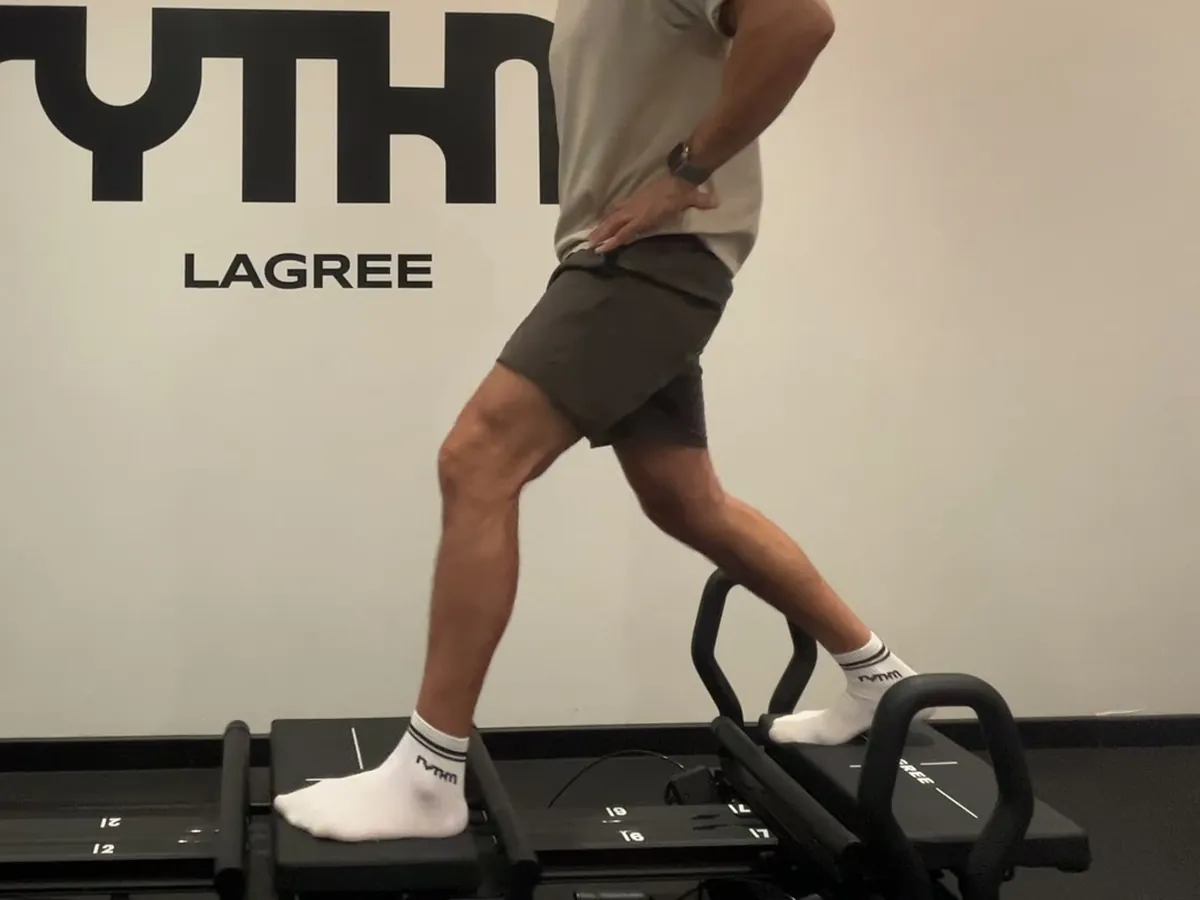
- One leg at a time. Lunges take up much of the lower-body work, one foot on a platform and the other on the carriage, which you hold back without jerking. The Runner’s lunge is done with the torso tilted to engage the glutes; the Hamstrings leg curls work the back of the thighs.
- Core. In the planks, the carriage moves back and forth while the centre of the body has to stay still. A class combines strength, endurance, balance and cardiovascular work.
What Lagree does not replace
The two studies of runners cited above look at weight training, explosive work and plyometrics. They do not look at Lagree, and they cannot be credited with results they never measured. Lagree is slow strength work with no jumping: it complements those forms of training, it does not reproduce them.
Nor does it replace running itself: endurance, pace and stride are trained by running. If you are working towards a time goal, keep the speed work in your plan. If you follow a plan with a coach or a club, talk it through with them.
How do you fit it into your running week?
The RYTHM coach recommends two Lagree classes a week, a pace explained in how many times a week to do Lagree. If you already run several times a week and are new to strength training, build up gradually and talk to the coach: for people who have never done it, the 2018 review stresses gradual progression, to avoid injury and overtraining, and supervision by a qualified coach.
If you come once a week, the monthly membership, with a six-month commitment, is designed for that pace; the 10-class pack, €305, valid 3 months, gives more flexibility and commits you to nothing. All the options are in the Prices section of the home page.
- Leave at least 24 hours between a Lagree class and a hard run: that is the gap the 2018 review recommends, as a strength session can cause enough fatigue to hamper the run that follows.
- A race is a hard effort: the safest choice is to skip Lagree the day before.
- If you are running on 1 November and are new to Lagree, mention it to the coach when you book; if in doubt, save your trial class for after the race.
- Pick a slot you can keep every week: the schedule changes with demand.
Trying Lagree in the Carmes district
RYTHM Lagree Studio’s Lagree classes in Toulouse take place at JBM Sports, 32 rue du Languedoc, 100 metres from Carmes metro station, on six Micro Pro machines. Each class lasts 50 minutes, with six people at most, and can be taught in English on request. The trial class is €30, with no commitment; you book it online, or in the Xplor Active app with the studio code Rythmlagree.
In a Google review written after a class in September 2026, Guillaume E. recommends it “to all runners who want to build strength work into their training” (our translation, the review is in French). The Runner’s lunge is one of the thirty-three exercises shown one by one in the coach’s video.
Looking for a gift for a runner? The studio’s gift cards are valid for one year and can be bought online.
Sources
- Blagrove R. C., Howatson G., Hayes P. R., “Effects of Strength Training on the Physiological Determinants of Middle- and Long-Distance Running Performance: A Systematic Review”, Sports Medicine, 2018
- Balsalobre-Fernández C., Santos-Concejero J., Grivas G. V., “Effects of Strength Training on Running Economy in Highly Trained Runners: A Systematic Review With Meta-Analysis of Controlled Trials”, Journal of Strength and Conditioning Research, 2016
- Lauersen J. B., Bertelsen D. M., Andersen L. B., “The effectiveness of exercise interventions to prevent sports injuries: a systematic review and meta-analysis of randomised controlled trials”, British Journal of Sports Medicine, 2014
- World Health Organization, “WHO guidelines on physical activity and sedentary behaviour”, 2020
- Harmonie Mutuelle Toulouse Métropole Run Experience, official site (marathon, half marathon and 10 km, 1 November 2026)
- Toulouse Métropole, events listing: “Harmonie Mutuelle - Toulouse Métropole Run Experience” (start and finish in the city centre, in French)
Frequently asked questions
Can I do Lagree the day before a race?
The safest choice is not to. A research review on runners recommends leaving at least 24 hours between a strength session and a hard run, and a race is one. If in doubt, ask the coach.
Does Lagree replace a run?
No. It strengthens the legs, glutes and core, with no impact, but endurance, pace and stride are trained by running. Lagree adds to your runs, it does not replace them.
How many strength sessions a week should a runner do?
Research reviews on runners point to two to three strength sessions a week, and the WHO recommends muscle-strengthening on at least two days a week for adults. The RYTHM coach recommends two Lagree classes a week; if you are new to strength training, build up gradually with him.